


Homes sell an estate, but infrastructure makes it work. Estate infrastructure in Kenya covers the roads, drains, water pipes, sewers, power cables and street lights that every house depends on. When it is done well, nobody notices. When it is done badly, roads wash out, compounds flood and water runs dry.
This guide explains each part of estate civil works, how it is designed and built, and which permits apply, so that landowners, developers and buyers know what to ask for.
Key takeaways
- Estate infrastructure is usually planned with the subdivision and built before or alongside the homes, because roads, drains and pipes share the same road reserves.
- Kenya's Ministry of Transport publishes a pavement design guideline for low volume sealed roads (PDG-1, 2017), a useful reference for lightly trafficked roads.
- Drilling a borehole without Water Resources Authority (WRA) authorisation is an offence, and a water permit is renewable every five years, according to the WRA.
- An on-site sewage treatment plant that discharges to the environment needs a NEMA effluent discharge licence, valid for one calendar year; a facility connected to the public sewer does not.
- Kenya Power quotations cover capital contribution, VAT and a meter deposit, and are valid for 90 days, according to its new connections FAQ.
What is estate infrastructure?
Estate infrastructure is the shared civil works that serve every plot in a housing development. Civil works means engineering construction other than buildings: earthworks, roads, drainage, pipes and cables. In a typical Kenyan gated estate it includes:
| Element | What it does |
|---|---|
| Estate roads | Access for residents, deliveries, refuse trucks and emergency vehicles |
| Storm-water drainage | Carries rainwater off roads and plots to a safe discharge point |
| Water supply and reticulation | Brings water to the estate and distributes it to each plot through a pipe network |
| Sewer or treatment | Collects wastewater and connects it to a public sewer or an on-site treatment plant |
| Power and lighting | Electricity supply to each plot and street lighting |
| Boundary and gate | Perimeter wall, gatehouse and controlled entrance |
If you are planning a full community, our guide to how gated community developments work explains where infrastructure fits in the wider process.
Who is responsible for roads in Kenya, and where do estate roads fit?
Public roads in Kenya are managed by different agencies according to their class. The Kenya Rural Roads Authority (KeRRA) says it manages, develops and maintains rural roads (classes D, E and others), while urban roads are managed by the Kenya Urban Roads Authority (KURA). County roads are the responsibility of county governments under the Constitution, as the High Court confirmed in June 2025, according to The Star.
Internal estate roads are different. They sit inside the development, are designed by the developer's engineers and are paid for by the developer. After handover they are usually maintained by the residents through a management company or management corporation, unless a county formally takes them over. Where an estate road joins a public road, or a sewer or water pipe crosses a road reserve, permission is needed from the agency that controls that road.
How are estate roads designed and built?
A good estate road is a layered structure, not just a surface. Engineers design it from the ground up:
- Subgrade: the natural ground, tested and compacted. Weak or expansive soils such as black cotton soil may need to be removed or treated.
- Sub-base and base: layers of selected gravel or crushed stone that carry the load.
- Surface: the wearing layer that vehicles drive on.
- Kerbs, camber and side drains: the shape that sheds water off the road quickly.
| Surface option | Strengths | Points to watch |
|---|---|---|
| Gravel | Lowest first cost | Dust, ruts and frequent regrading |
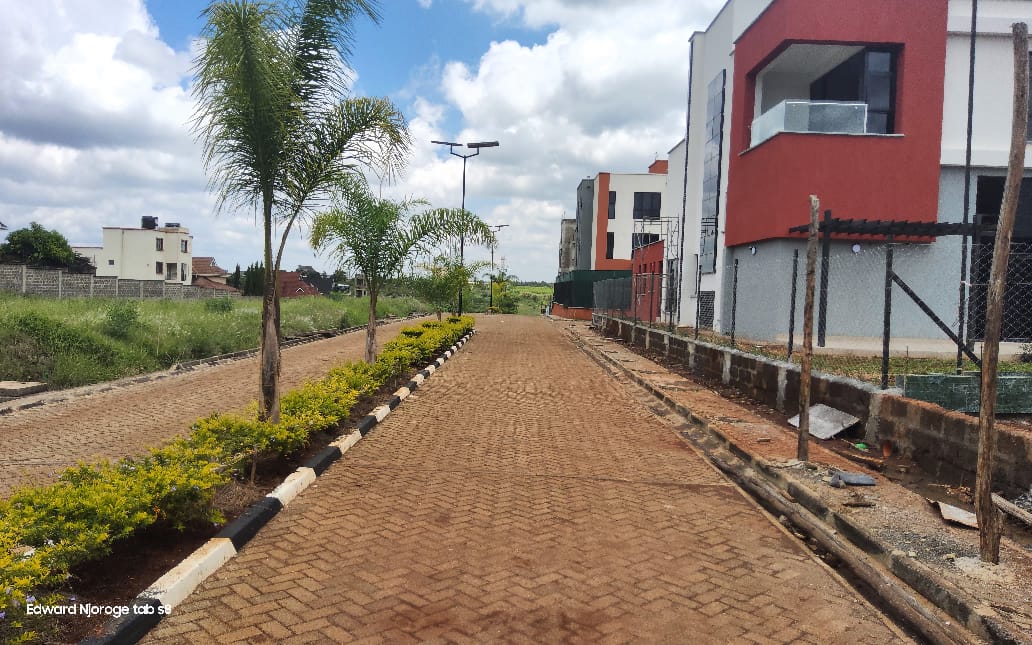
| Concrete paving blocks (cabro) | Durable, easy to lift and relay for repairs, common in estates | Needs a well-compacted base and edge restraint |
| Bitumen (tarmac) | Smooth, quiet, suits heavier traffic | Needs specialist plant and good drainage |
Estate roads carry light traffic, so they are often designed as low volume roads. PDG-1, the 2017 pavement design guideline for low volume sealed roads developed by the Ministry of Transport's Materials Testing and Research Department, aims for designs that keep construction and maintenance costs down. Road reserves should also be wide enough to carry water pipes, sewers and power cables beside the carriageway.
How should storm-water drainage be planned?
Drainage is the part of estate infrastructure that most often fails, and failures are expensive. Engineers start by working out how much rainwater the estate's roofs, roads and paved areas will shed, then design a network to carry it away:
- Side drains along roads, often lined with concrete or stone pitching to stop erosion.
- Culverts where water crosses under roads and driveways.
- Outfalls to a natural watercourse or public drain, with permission where needed.
- Soakaways or retention on plots to slow run-off.
Respect riparian land. NEMA's simplified Water Quality Regulations 2024 prohibit cultivation or development within six to thirty metres of the highest recorded flood level of a river or stream, as determined by NEMA. Check this before laying out plots near water.
How do you get water to an estate?
There are two main sources, and many estates use both.
Water services provider. Where mains are close, the estate connects to the local water company. Water services providers are licensed and regulated by the Water Services Regulatory Board (WASREB). The developer then builds storage tanks and a reticulation network, the pipe system that takes water to each plot.
Borehole. Where mains are far or unreliable, a borehole is common. The WRA permit process includes an application with a hydrogeological assessment, public notification, technical evaluation, authorisation to construct, a borehole completion record and water quality report, and then a permit renewable every five years. A Nation explainer from April 2026 says a typical borehole is 100 to 250 metres deep and costs about KSh 1.2 million to KSh 3 million or more, depending on location, geology and pump size. Only WRA-licensed drillers should be used.
What are the options for sewage in an estate?
Public sewer. Where a sewer is nearby, the estate's internal sewers connect to it. In Nairobi, Nairobi Water's instructions say no connection application is allowed until the drawing showing the plan, ground levels and invert levels has been approved and stamped. The applicant buys the materials, and work in a public road reserve needs permission from the road agency.
On-site treatment. Where there is no sewer, an estate can build its own treatment plant. If treated effluent is discharged to the environment, NEMA requires an effluent discharge licence. NEMA's FAQs say the application fee is KSh 10,000, licence fees range from KSh 11,000 to KSh 550,000 depending on the facility, and a licence is valid for one calendar year. A facility connected to the sewer, or whose wastewater is collected by a NEMA-licensed exhauster, does not need one. NEMA does not prescribe a particular treatment technology, but the effluent must meet discharge standards.
How do you bring power and lighting into an estate?
Kenya Power designs the supply and issues a quotation. Its new connections FAQ groups applications by load: Standard (below 25 kVA), Premium (25 to 999 kVA) and Premium Large (above 1,000 kVA). Premium applicants must provide a scaled site plan and load schedule. A registered electrical contractor issues the wiring certificates, which are submitted electronically through a portal shared by Kenya Power and the Energy and Petroleum Regulatory Authority (EPRA).
Inside the estate, many developers run cables underground in the road reserve for safety and appearance, and use solar street lights, which keep working during outages and avoid a lighting electricity bill.
Which approvals apply to estate infrastructure?
| Item | Typical approval | Issued by |
|---|---|---|
| Layout, roads and subdivision | Development permission | County planning authority |
| Estate as a whole | Environmental licence | NEMA |
| Borehole | Authorisation to construct, then water permit | Water Resources Authority |
| Water and sewer connections | Connection approval and stamped drawings | Local water services provider |
| On-site treatment plant | Effluent discharge licence | NEMA |
| Power | Quotation and connection | Kenya Power |
| Works in a public road reserve | Road reserve permission | Relevant road agency |
| Construction works | Project registration | National Construction Authority (NCA) |
For the building side, see our guide to building plan approval in Nairobi.
In what order is estate infrastructure built?
- Survey and design: topographic survey, soil tests, road, drainage, water, sewer and power designs.
- Approvals: county, NEMA, WRA, water company and Kenya Power applications.
- Earthworks and road formation: clearing, cutting and filling, compacting the subgrade.
- Underground services: sewers, water mains and power ducts laid in the road reserve before the road is surfaced.
- Drainage: side drains, culverts and outfalls.
- Road pavement: base layers, kerbs and surface.
- Power, lighting and finishing: cables, street lights, landscaping and the gate.
Laying pipes and ducts before surfacing avoids digging up a new road later. Our guide to how long it takes to build a house in Kenya covers timelines for the homes that follow.
How Msingi can help
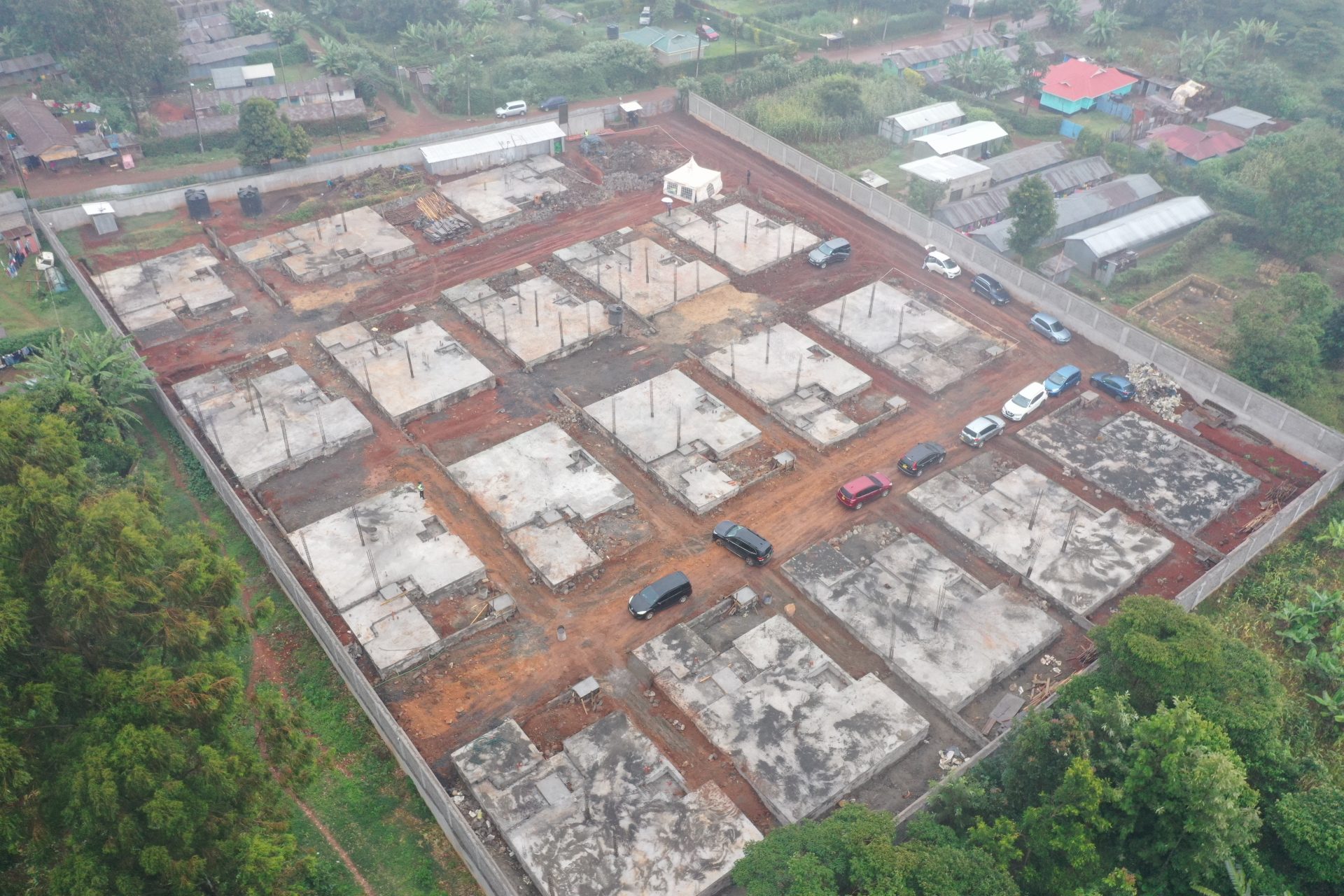
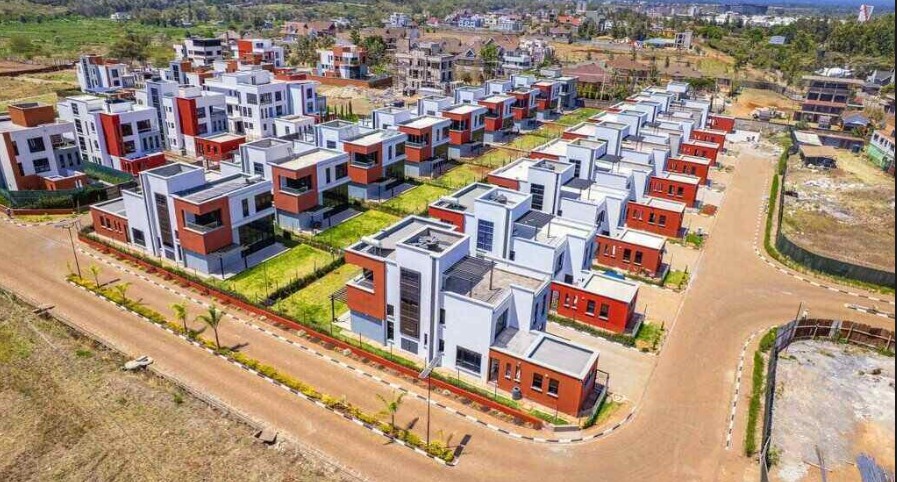
Msingi Engineering Group (Msingi) is an NCA-registered design-build contractor in Nairobi whose civil works cover roads, drainage, sewer, water reticulation, and power and utilities. At 143 Brook View, Msingi delivered estate infrastructure including roads, drainage and lighting. It also delivered civil works and building services for the Zipline KE-1 distribution centre in Chemelil, Kisumu County, in 2023, and is building Goshenville, a Msingi family community with 18 foundations underway. Engineering and construction are coordinated by one accountable team. To discuss estate infrastructure for your land, start an enquiry.
Frequently asked questions
What does estate infrastructure include?
Estate infrastructure is the shared civil works that serve every plot: internal roads, storm-water drains and culverts, water supply with storage and reticulation, sewers or an on-site treatment plant, power supply, street lighting, and usually a boundary wall and gatehouse. It is designed by engineers with the estate layout and is normally built before or alongside the homes.
What is the best road surface for an estate road in Kenya?
It depends on traffic, budget and maintenance. Gravel is cheapest to build but needs frequent regrading. Concrete paving blocks (cabro) are common in estates because they are durable and easy to repair. Bitumen gives a smooth surface for heavier traffic. Whatever the surface, the road needs a properly compacted base and good drainage to last.
Do I need a permit to drill a borehole in Kenya?
Yes. Drilling without Water Resources Authority authorisation is an offence. The process includes an application with a hydrogeological assessment, public notification, technical evaluation, authorisation to construct, a completion record and water quality report, and then a water permit, renewable every five years. A NEMA environmental assessment may also apply. Use a WRA-licensed driller.
Does an estate sewage treatment plant need a NEMA licence?
If the plant discharges treated effluent into the environment, yes: NEMA requires an effluent discharge licence, valid for one calendar year. NEMA's FAQs say a facility connected to the public sewer, or whose wastewater is collected by a NEMA-licensed exhauster, does not need one. The effluent must meet NEMA's discharge standards, whatever treatment technology is used.
Who maintains estate roads after the developer leaves?
Internal estate roads are usually private. After handover, residents normally maintain them through a management company, or a management corporation in a sectional scheme, funded by service charges. A county may take over roads only through a formal process. Before buying, ask who owns the roads and how maintenance is funded.
How do you get electricity to a new estate in Kenya?
Apply to Kenya Power through its online self-service portal. Kenya Power designs the supply and issues a quotation covering capital contribution, VAT and a meter deposit, valid for 90 days. Larger loads (25 kVA and above) need a scaled site plan and load schedule. A registered electrical contractor must issue the wiring certificates.
Sources
- Pavement Design Guidelines PDG-1: Pavement Design Guideline for Low Volume Sealed Roads, 2017 (GOV.UK research outputs)
- Frequently asked questions (Kenya Rural Roads Authority)
- Water use allocation and permitting (Water Resources Authority)
- Sinking a borehole? Here's what you need to know (Nation, April 2026)
- Court orders restoration of road maintenance funds to counties (The Star, June 2025)
- Licence register (Water Services Regulatory Board)
- Water Quality Management in Kenya: Simplified Water Quality Regulations 2024 and FAQs (NEMA)
- Water and sewer application instructions (Nairobi City Water and Sewerage Company)
- New connections FAQ (Kenya Power)
Planning a build?
Tell us about your plot, plans and timing. A Msingi partner will call you within one working day.
Start your enquiry